



When dealing with engineering air conditioning systems, accurately calculating the pressure drop in copper capillary tubes is crucial for the system's efficiency and performance. As a supplier of Engineering Air Conditioning Copper Capillary Tubes, I have in - depth knowledge and experience in this area. This blog aims to provide a comprehensive guide on how to calculate the pressure drop in these capillary tubes.
1. Understanding the Basics of Pressure Drop
Pressure drop refers to the decrease in pressure that occurs as a fluid (in this case, refrigerant in air - conditioning systems) flows through a pipe. In air conditioning copper capillary tubes, this pressure drop is a critical factor as it affects the refrigerant flow rate, cooling capacity, and overall system efficiency. A miscalculation of pressure drop can lead to under - or over - cooling, increased energy consumption, and potential system failures.
2. Factors Affecting Pressure Drop in Copper Capillary Tubes
2.1 Tube Dimensions
The inner diameter ($d$) of the copper capillary tube plays a significant role in pressure drop. A smaller inner diameter leads to higher fluid velocity and, consequently, a greater pressure drop. The length ($L$) of the tube also matters; as the length increases, the friction between the fluid and the tube wall increases, resulting in a larger pressure drop.
2.2 Refrigerant Properties
The type of refrigerant used in the air - conditioning system has a substantial impact. Different refrigerants have varying densities ($\rho$), viscosities ($\mu$), and specific heats. For example, R - 410A has different flow characteristics compared to R - 22, which affects the pressure drop. Additionally, the state of the refrigerant (liquid, vapor, or two - phase mixture) is a critical factor. In a two - phase flow, the interaction between the liquid and vapor phases makes the pressure drop calculation more complex.
2.3 Flow Rate
The mass flow rate ($\dot{m}$) of the refrigerant through the capillary tube is directly related to the pressure drop. A higher flow rate increases the fluid velocity and the frictional forces, leading to a larger pressure drop.
3. Pressure Drop Calculation Methods
3.1 Single - Phase Flow
For single - phase liquid or vapor flow in the capillary tube, the Darcy - Weisbach equation is commonly used:
$\Delta P = f\frac{L}{d}\frac{\rho v^{2}}{2}$
where $\Delta P$ is the pressure drop, $f$ is the friction factor, $L$ is the length of the tube, $d$ is the inner diameter, $\rho$ is the fluid density, and $v$ is the fluid velocity.
The friction factor $f$ can be determined using different correlations. For laminar flow ($Re<2300$), where the Reynolds number $Re=\frac{\rho vd}{\mu}$, the friction factor is given by $f = \frac{64}{Re}$. For turbulent flow ($Re > 4000$), more complex correlations such as the Colebrook equation or the Moody chart are used.
3.2 Two - Phase Flow
Two - phase flow in air - conditioning capillary tubes is more complicated. One of the widely used methods is the homogeneous model. In this model, the two - phase mixture is considered as a homogeneous fluid with average properties. The pressure drop is calculated using a modified Darcy - Weisbach equation:
$\Delta P = f_{tp}\frac{L}{d}\frac{\rho_{tp} v_{tp}^{2}}{2}$

where $f_{tp}$ is the two - phase friction factor, $\rho_{tp}$ is the two - phase mixture density, and $v_{tp}$ is the two - phase mixture velocity.
Another approach is the separated flow model, which considers the liquid and vapor phases separately and accounts for the interaction between them. The Lockhart - Martinelli correlation is often used in the separated flow model to estimate the two - phase pressure drop.
4. Practical Considerations in Calculation
4.1 Tube Fittings
In real - world air - conditioning systems, copper capillary tubes may have fittings such as elbows, tees, or valves. These fittings introduce additional pressure losses. The equivalent length method can be used to account for these losses. Each fitting is assigned an equivalent length of straight tube, and this length is added to the actual tube length in the pressure drop calculation.
4.2 Tube Material and Surface Roughness
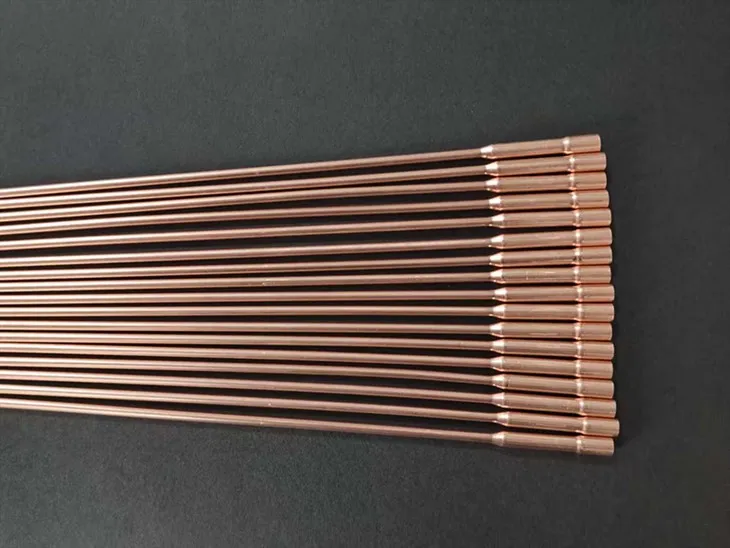
The material of the copper capillary tube (such as TP2 copper) and its surface roughness can affect the friction factor. A smoother inner surface of the tube reduces the frictional resistance and, thus, the pressure drop. Our company offers high - quality Reducing - expanding TP2 Copper Capillary Tube, Flared TP2 Copper Capillary Tube, and Reduced - Diameter Flared Copper Capillary Tube with precisely controlled surface roughness to minimize pressure drop.
5. Using Software and Tools for Calculation
While manual calculations can provide a basic understanding of pressure drop, using specialized software and online tools can offer more accurate and efficient results. Software programs can take into account complex refrigerant properties, two - phase flow behavior, and the effects of tube fittings. These tools often have built - in databases of refrigerant properties and can generate detailed reports of pressure drop calculations.
Conclusion
Accurately calculating the pressure drop in engineering air conditioning copper capillary tubes is a multi - faceted process that requires a good understanding of fluid mechanics, refrigerant properties, and tube characteristics. By considering the factors mentioned above and using appropriate calculation methods, engineers can design air - conditioning systems that operate efficiently and reliably.
As a leading supplier of Engineering Air Conditioning Copper Capillary Tubes, we are committed to providing high - quality products to meet your specific requirements. Our capillary tubes are manufactured to strict standards, ensuring consistent quality and performance. If you are in the process of designing or upgrading an air - conditioning system, or if you have any questions about pressure drop calculations or our products, please feel free to contact us for procurement and further discussions.
References
- Incropera, F. P., & DeWitt, D. P. (2002). Fundamental of Heat and Mass Transfer. Wiley.
- Cengel, Y. A., & Turner, R. H. (2006). Fundamentals of Thermal - Fluid Sciences. McGraw - Hill.
- Stoecker, W. F. (1989). Refrigeration and Air Conditioning. McGraw - Hill.


